INDICATIONS AND USAGE
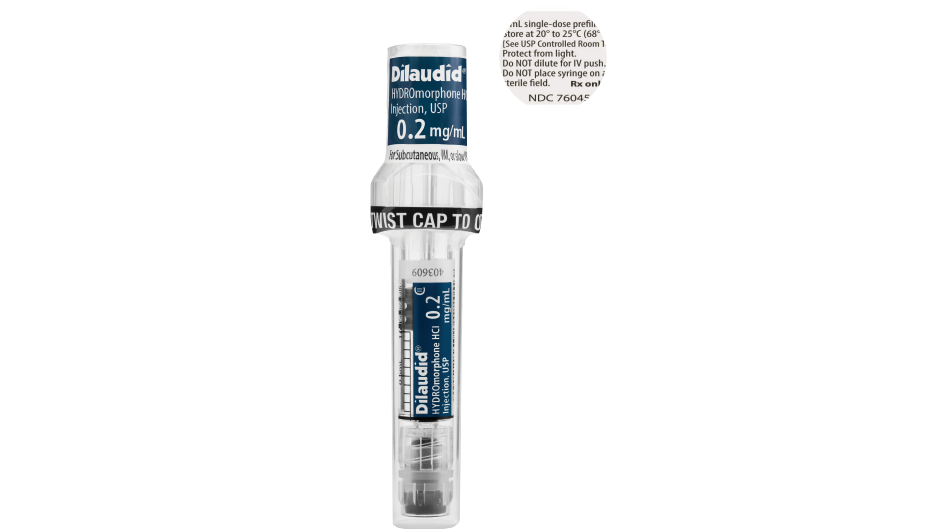
DILAUDID INJECTION (hydromorphone hydrochloride) for intravenous, intramuscular, or subcutaneous use, is an opioid agonist indicated for the management of pain severe enough to require an opioid analgesic and for which alternate treatments are inadequate.
Limitations of Use: Because of the risks of addiction, abuse, misuse, overdose, and death, which can occur at any dosage or duration, and persist over the course of therapy, reserve opioid analgesics, including DILAUDID INJECTION for use in patients for whom alternative treatment options are ineffective, not tolerated, or would be otherwise inadequate to provide sufficient management of pain.
Do not rapidly reduce or abruptly discontinue DILAUDID INJECTION in patients who may be physically dependent on opioids.
CONTRAINDICATIONS
DILAUDID INJECTION is contraindicated in patients with:
- Significant respiratory depression.
- Acute or severe bronchial asthma in an unmonitored setting or in absence of resuscitative equipment.
- Known or suspected gastrointestinal obstruction, including paralytic ileus.
- Known hypersensitivity to hydromorphone, hydromorphone salts, sulfite-containing medications, or any other components of the product.
WARNINGS AND PRECAUTIONS
- Opioid-Induced Hyperalgesia and Allodynia: Opioid-Induced Hyperalgesia (OIH) occurs when an opioid analgesic paradoxically causes an increase in pain, or an increase in sensitivity to pain. If OIH is suspected, carefully consider appropriately decreasing the dose of the current opioid analgesic, or opioid rotation.
- Life-Threatening Respiratory Depression in Patients with Chronic Pulmonary Disease or in Elderly, Cachectic, or Debilitated Patients: Monitor closely, particularly during initiation and titration.
- Adrenal Insufficiency: If diagnosed, treat with physiologic replacement of corticosteroids, and wean patient off of the opioid.
- Severe Hypotension: Monitor during dosage initiation and titration. Avoid use of DILAUDID INJECTION in patients with circulatory shock.
- Risks of Use in Patients with Increased Intracranial Pressure, Brain Tumors, Head Injury, or Impaired Consciousness: Monitor for sedation and respiratory depression. Avoid use of DILAUDID INJECTION in patients with impaired consciousness or coma.
- DILAUDID INJECTION contains sodium metabisulfite: There is a risk of anaphylactic symptoms and life-threatening asthmatic episodes in susceptible people.
ADVERSE REACTIONS
Serious adverse reactions associated with DILAUDID INJECTION include respiratory depression and apnea and, to a lesser degree, circulatory depression, respiratory arrest, shock, and cardiac arrest.
The most common adverse reactions are lightheadedness, dizziness, sedation, nausea, vomiting, sweating, flushing, dysphoria, euphoria, dry mouth, and pruritus.
Opioid-induced esophageal dysfunction (OIED): Cases of OIED have been reported in patients taking opioids and may occur more frequently in patients taking higher doses of opioids, and/or in patients taking opioids longer term
To report SUSPECTED ADVERSE REACTIONS, contact Fresenius Kabi USA, LLC at 1-800-551-7176 or FDA at 1-800-FDA-1088 or www.fda.gov/medwatch.
DRUG INTERACTIONS
- Serotonergic Drugs: Concomitant use may result in serotonin syndrome. Discontinue DILAUDID INJECTION if serotonin syndrome is suspected.
- Monoamine Oxidase Inhibitors (MAOIs): Can potentiate the effects of hydromorphone. Avoid concomitant use in patients receiving MAOIs or within 14 days of stopping treatment with an MAOI.
- Mixed Agonist/Antagonist and Partial Agonist Opioid Analgesics: Avoid use with DILAUDID INJECTION because they may reduce analgesic effect of DILAUDID INJECTION or precipitate withdrawal symptoms.
USE IN SPECIFIC POPULATIONS
Pregnancy: May cause fetal harm.
OVERDOSAGE
Acute overdose with hydromorphone can be manifested by respiratory depression, somnolence progressing to stupor or coma, skeletal muscle flaccidity, cold and clammy skin, constricted pupils, and, in some cases, pulmonary edema, bradycardia, hypotension, hypoglycemia, partial or complete airway obstruction, atypical snoring, and death. Marked mydriasis, rather than miosis, may be seen with hypoxia in overdose situations. Toxic leukoencephalopathy has been reported after opioid overdose and can present hours, days, or weeks after apparent recovery from the initial intoxication.
In case of overdose, priorities are the reestablishment of a patent airway and protected airway and institution of assisted or controlled ventilation, if needed. Employ other supportive measures (including oxygen and vasopressors) in the management of circulatory shock and pulmonary edema as indicated. Cardiac arrest or arrhythmias will require advanced life-support measures. For clinically significant respiratory or circulatory depression secondary to hydromorphone overdose, administer an opioid overdose reversal agent such as naloxone or nalmefene. Because the duration of opioid reversal is expected to be less than the duration of hydromorphone in DILAUDID INJECTION, carefully monitor the patient until spontaneous respiration is reliably reestablished.
This important safety information does not include all the information needed to use DILAUDID INJECTION safely and effectively. Please see full prescribing information, including BOXED WARNING, for Dilaudid Injection.





 Explore products